ServicesGutters
Gutters in Seal Beach, Hung to Carry Water Away From Your Home
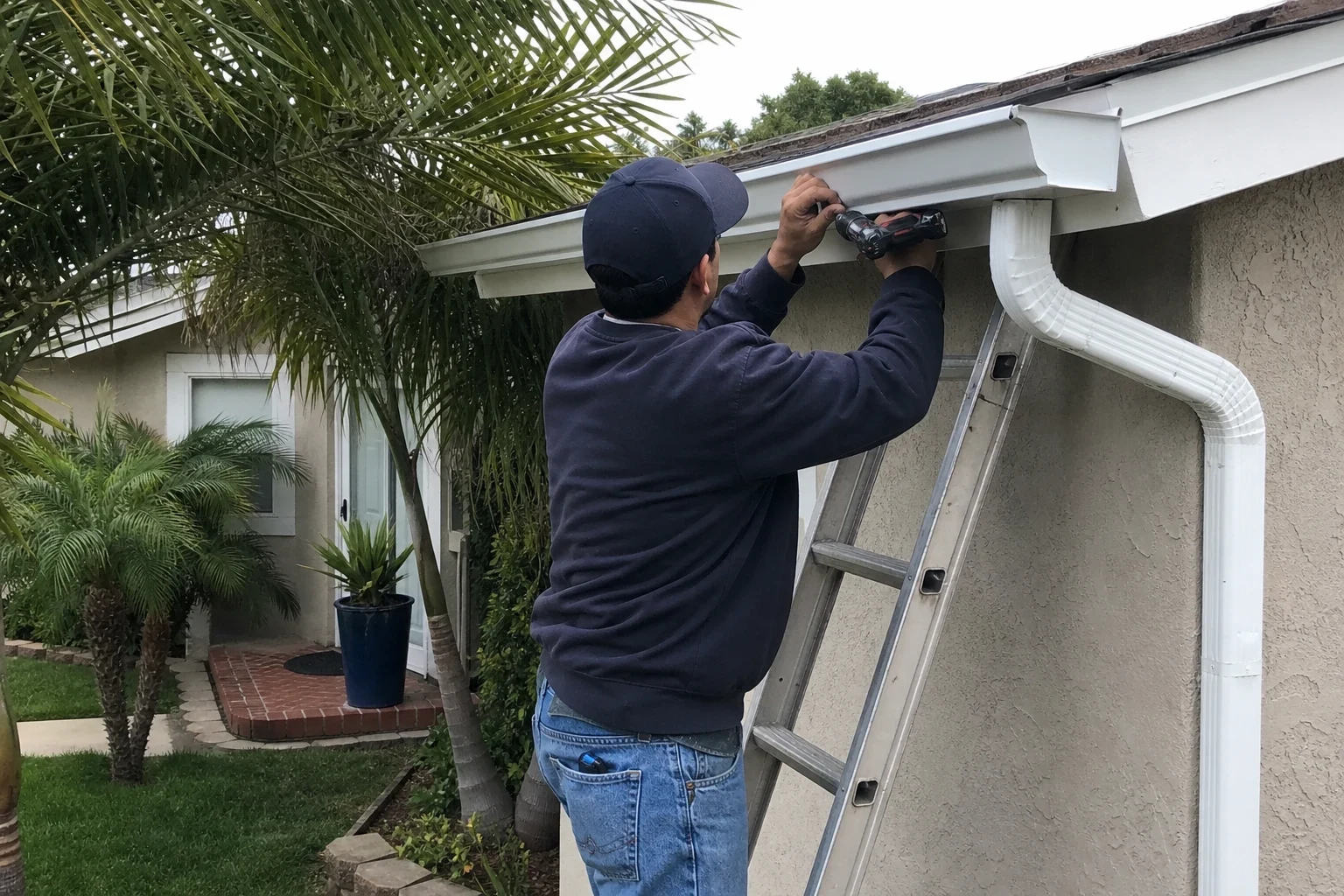
We install and repair aluminum gutters and downspouts. Every run is pitched to its outlet, hung on hidden hangers into solid fascia, and tied in under the roof edge so water lands in the trough instead of behind it. The same small crew measures and installs.
What Gutters Do and When the Work Is Worth It
A gutter has one job: collect roof runoff and move it to a downspout that discharges away from your foundation, siding and walkways. When it fails, it rarely fails all at once. A sag lets water pool, a miter joint opens, or a run pulls off a rotted fascia board, and the overflow soaks the wall and the soil beside it.
Near the coast, material matters. Salt air works on galvanized steel and exposed fasteners, so we install aluminum gutters with stainless or coated screws and keep dissimilar metals apart. Short, heavy winter storms are exactly when an undersized downspout or a flat spot in the run shows up.
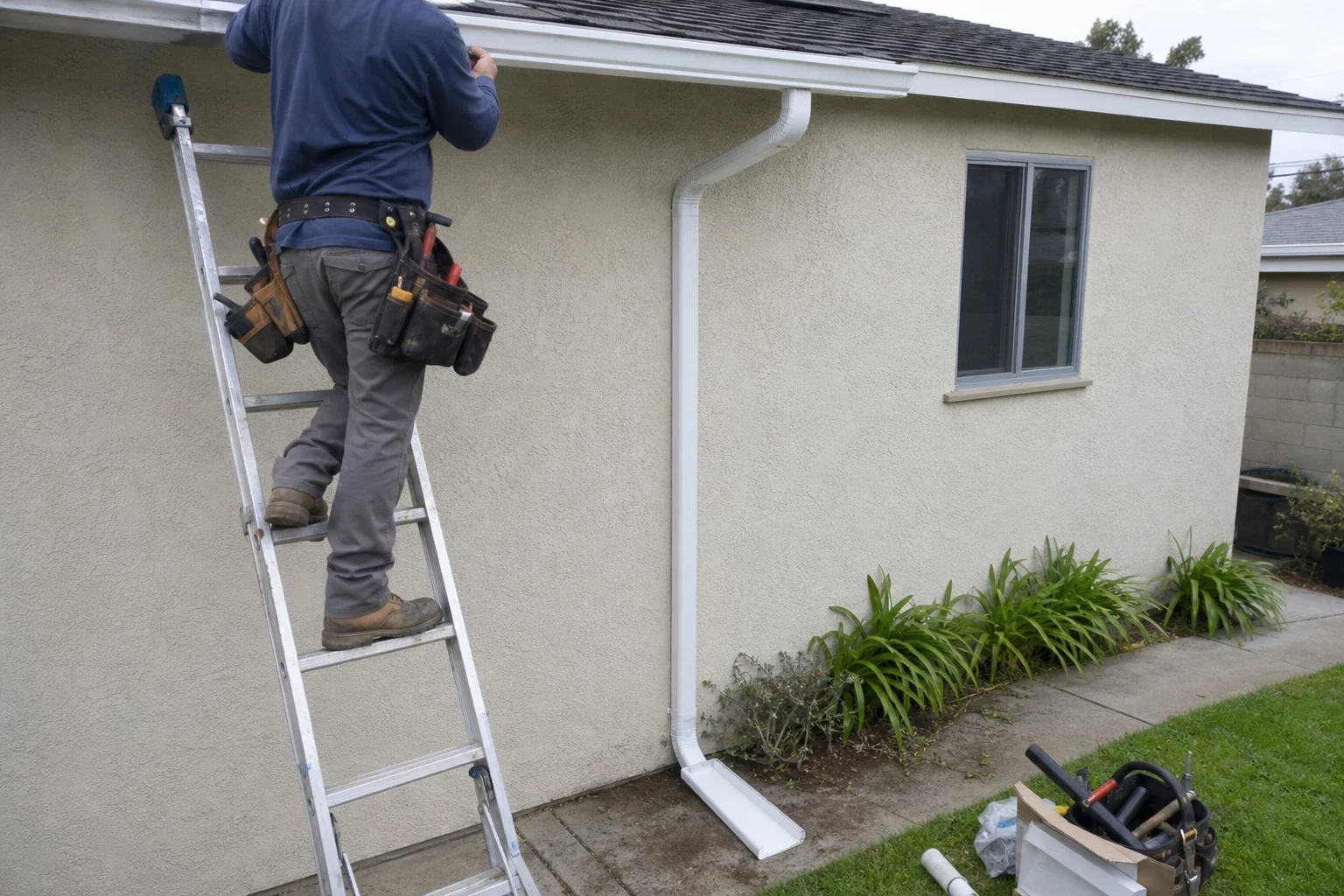
Our crew stays small on purpose. The person who measures your eaves and checks the fascia is on the ladder on install day, so nothing gets lost between the estimate and the work.
What a Gutter Job Includes
- Measuring and sizing
- We measure each eave run and look at the roof area draining into it. Most homes take a 5-inch K-style profile; steep or large roof planes, and tile roofs that shed a lot of water at once, often need 6-inch gutters.
- Continuous runs formed on site
- We roll aluminum gutter stock to the exact length of each eave right at your home, so a run has no splices along its length. Joints exist only where the gutter turns a corner or stops, which leaves very little sealant exposed to sun and weather.
- Correct pitch and hidden hangers
- We set a slope of about a quarter inch per ten feet toward each outlet and fasten hidden hangers roughly every two feet with screws, not spikes. That spacing keeps the trough from bowing when it fills with water or leaves.
- Fascia and drip edge check
- Before hanging anything, we probe the fascia for rot and confirm the drip edge or gutter apron laps into the gutter. If the fascia is soft, we tell you and show you before replacing it.
- Downspouts and discharge
- We size downspouts to the roof area, often stepping up from 2x3 to 3x4 inch on long runs, and add elbows, extensions or splash blocks so water leaves the base of the wall.
- Repairs on gutters you keep
- Resealing miters and end caps, re-pitching sagging sections, replacing failed hangers and clearing clogged downspouts, when the existing gutter is sound enough to be worth fixing.
Warning Signs in Your Gutters
Overflow during an ordinary rain
If water sheets over the lip when the rain is only moderate, look for a clog, a section that has lost its slope, or a downspout too small for the roof above it.
Streaks or stains on the siding
Dark lines below the gutter point to water running behind the trough, typically from a missing gutter apron or a gap at the fascia.
Sagging or pulled-away sections
A run that dips or leans out has lost hanger grip, often because the fascia behind it has softened.
Drips at corners and end caps
Old sealant shrinks and cracks with sun exposure, and the miters open first.
Rust, pitting or white powder
Rust on steel gutters and chalky corrosion where metals touch tell you the material is breaking down in the salt air.
Puddles or erosion at the foundation
If a downspout dumps right at the wall, water collects where your home's footing sits. An extension or relocated outlet usually solves it.
What Moves the Price of Gutters
Gutter pricing comes down mostly to length and complexity. A single-story ranch with straight eaves costs far less per foot than a two-story home with many corners. Your written estimate lists each part of the job as its own line, so nothing is lumped together.
Total footage and miters
The combined length of all runs sets the base. Every inside or outside corner adds labor and one more sealed joint.
Gutter size and metal gauge
Six-inch gutters and heavier 0.032-inch aluminum cost more than 5-inch stock, but they carry more water and resist denting from ladders.
Fascia condition
Replacing rotted fascia boards before hanging new gutters adds material and time, and it is the step that keeps the new run from pulling loose.
Height and access
Second-story eaves, steep slopes and tight side yards slow the ladder work.
Downspouts and extras
Larger downspouts, added outlets, extensions and gutter guards each add to the total. Financing is available through Service Finance Company, subject to credit approval.
How the Work Goes
- 1
Estimate on site
We walk the eaves, check the fascia and drip edge, note how the roof drains, and give you a free written estimate listing gutter size, footage, downspouts and any fascia repair.
- 2
Old gutters come down
We remove the existing runs and hangers, then inspect the exposed fascia board. Any surprise rot is photographed and discussed with you before we touch it.
- 3
Forming and hanging
The gutter machine rolls each run to length in your driveway. We snap a pitch line, set hidden hangers into sound wood and seal the corners and end caps.
- 4
Flow test and cleanup
Once the last run is up, we send a steady stream of water into the far end of each gutter and confirm it travels to the downspout with nothing left standing in the trough. If a spot holds water, we adjust the hangers right then. After that we haul away the old metal and sweep the yard for loose screws and trim scraps.
Common Gutter Questions
Can my existing gutters be fixed, or do they need replacing?
When the metal is still solid and the trouble is a couple of open joints or one drooping section, a repair usually does the job. When the gutters are rusting, pitted or failing in several spots, new runs cost less over time than patching leak after leak. We will tell you which way to go and show you what we saw.
Why aluminum instead of steel near the beach?
Galvanized steel rusts once its zinc coating wears through, and salt air speeds that up. Aluminum does not rust, and with stainless or coated fasteners it holds up well near the coast. We also avoid touching aluminum to copper, which causes galvanic corrosion.
Should I replace gutters at the same time as my roof?
It is often the right time, because the drip edge and gutter apron are being replaced anyway and we can tie them together properly. If you are planning a roof replacement, CertainTeed SureStart PLUS 3-Star manufacturer coverage is available on the roof, and we coordinate the gutters with that work.
Do gutter guards really help?
They cut down on how often you clean, especially under trees that drop small leaves or needles. They do not end maintenance, since fine debris still collects. We will tell you honestly if your roof and trees make them worth it.
Is your company licensed and insured for this work?
Yes. We are a licensed roofing contractor, CSLB 1092407 (C-39), and we are insured. We also offer service in English and Spanish.
Get Your Gutters Measured by the Crew That Installs Them
We serve Seal Beach and nearby towns, including Long Beach, Huntington Beach, Rossmoor and Los Alamitos. One call sets up a visit and a written price.